
Every pilot remembers the first flights of their career, the ones that finally put the many hours of theory to practical use and delivered their wonderful reward. At some point during that time, every student pilot receives a shorter or longer briefing from their flight instructor on how to keep a personal pilot logbook.
While the logbook is kept eagerly and conscientiously during training, the obligation to maintain it often turns into a tedious administrative task for commercial pilots later in their career, one that also eats into valuable time.
This article explains why the effort of keeping a detailed and careful logbook is worthwhile, and how the time spent on it can be reduced without compromising compliance.
The logbook is a legally relevant document
The pilot logbook is much more than a personal record of flights. It is a legally required proof of flight experience, on the basis of which prerequisites for license endorsements, privileges and their maintenance are assessed.
Its function is therefore more comparable to an academic transcript or a medical certificate than to a diary: authorities, insurers and other third parties rely on the flights and evidence documented in it to be accurate.
Accordingly, European aviation law explicitly names the falsification of a logbook as a possible reason for the restriction, suspension or revocation of a pilot license (see, among others, ARA.FCL.250(a)(2)).
Under criminal law too, a logbook may qualify as a document with legal force. In the spirit of professional airmanship, it should therefore be kept carefully, accurately and traceably.
The risk of accident investigation
You take out liability insurance in the hope of never needing it. A pilot logbook works in much the same way. As long as nothing extraordinary happens, it does not matter much how it is kept. In some careers the logbook sits as a silent companion; sometimes it is not even kept at all, and in most classic airline careers this has no consequences.
But should an actual loss event occur one day, all factors that could potentially have contributed to the cause will be examined closely and categorized. The investigating authority, and above all the insurer and the responsible operator, will begin searching for potential culprits to avoid being held liable themselves for what are usually very large sums.
Pilots tend to come into focus early in investigations, and a comprehensive picture is built up of each involved pilot's working methods, mental state and competencies. Flight planning and preparation are analyzed, interviews conducted with colleagues, training results and any weaknesses reviewed. The personal logbook is always inspected, assessed and verified.
A well-maintained logbook can be decisive in insurance terms. Courts internationally have already denied coverage where insurance conditions explicitly required "logged flying hours" and the actual flight experience on record did not match what was documented in the logbook. (See North American Specialty Insurance Co. v. Myers, 111 F.3d 1273 (6th Cir. 1997) and Marson Coal Co. v. Insurance Company of the State of Pennsylvania (W. Va. 1974))
The logbook as a showcase for your working style
It is not only in the context of accident investigations that logbook keeping can have very concrete effects on a pilot's career, opportunities and risks. The logbook serves broadly as a showcase for one's working methods and gives an indication of how carefully and diligently one works. The quality of entries shows how important regulatory compliance is to someone and whether they maintain an overview even under stress in order to fulfill their documentation obligations.
Even the choice of logbook is a statement. Opting for a digital solution demonstrates a confident command of technology and a modern outlook. Choosing a high-quality paper book with a fine cover shows groundedness and discipline. Keeping no logbook at all conveys a certain carelessness and appetite for risk.
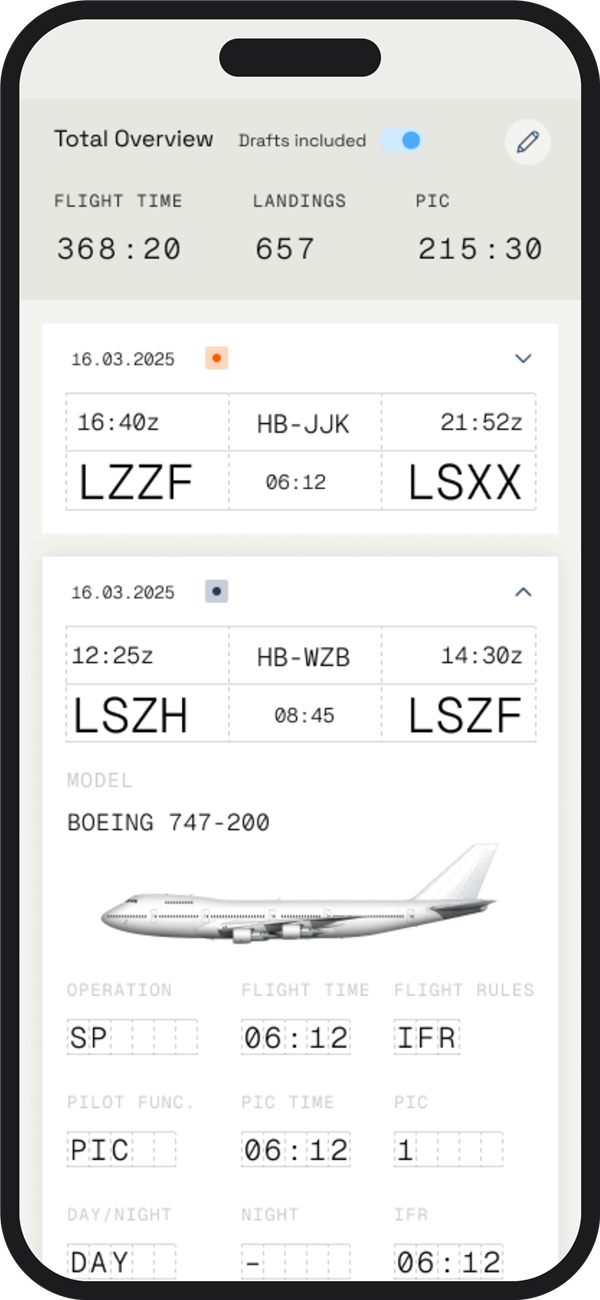
Pilots are often unaware that their logbook will be inspected by a wide variety of parties: authorities, employers, training organizations, flight instructors and examiners, insurers, customers, SAFA inspectors, and aero clubs.
Later in this article I will look at some of these situations in more detail. In the second part, I address the importance of the logbook for career development and job applications.
Commercial pilots are also personally obliged to keep a logbook
Many pilots holding an EASA CPL or ATPL license are often unaware that the legal requirement applies to them just as it does to pilots in single-pilot operations.
A common misconception is that the company's IT systems automatically handle this task on their behalf. A crew rostering system, a payroll system, or a list of sectors flown is not automatically a personal logbook compliant with FCL.050. This misunderstanding is particularly widespread among pilots at larger operators such as airlines or business jet operators.
This misunderstanding stems from a typical misreading of AMC1 FCL.050 (e), which states that an employer may assume this obligation on behalf of its pilots.
(…) details of flights flown under commercial air transport may be recorded in an electronic format maintained by the operator (…)
The key word here is "may", which merely leaves open the possibility, but in no way obliges the operator to do so as "must" or "shall" would require.
Why your airline does not want to keep your logbook
The misconception that the airline keeps the personal logbook for its pilots is widespread and carries real risks for the pilot.
From the operator's perspective, the situation is usually quite clear. There is no real benefit to the business in assuming this obligation for its pilots, other than perhaps a certain employee benefit and thus greater attractiveness as an employer.
On the other hand, the IT department would then need to meet far more comprehensive requirements, which brings costs and risks. All the provisions of FCL.050 would need to be implemented in the operator's IT system, including electronic signatures, which in turn raises questions about accessibility for former employees and consequently directly safety-relevant issues.
A solution must also be found for employees who fly for another operator, work as flight instructors, or fly privately. The personal logbook must capture all flight activities, and few airlines have any desire to manage single-pilot flights in their systems. Would these employees then need to maintain multiple fragmented records? And how can they transfer the data compliantly once they leave the company but continue flying?
Most airlines and operators therefore decide pragmatically: each pilot is personally responsible for keeping their own logbook. It is worth checking the employer's OM-A to see whether anything is written on this, usually under Chapter 7. Often it states explicitly that the airline does not keep the personal logbook for you. In most operations, however, nothing will be written on the subject, which also means that they are not assuming this responsibility. Remember the word "may".
Flight and duty time limits
Fragmented data is also a genuine problem for airlines themselves, because in the area of duty and flight time limits under Subpart FTL there is an additional liability to ensure that no illegal flights are conducted in violation of working time or flight time limits.
Compliance is on the one hand the responsibility of the pilot under CAT.GEN.MPA.100 (b) (4) and (5), while the operator must also ensure under ORO.FTL.100 that limits are observed, and that data is collected, stored and made accessible to the pilot and other operators under ORO.FTL.245.
The regulations therefore clearly place explicit responsibility on both parties to ensure these limits are not violated. Both crew planners and flight crew are legally obligated to guarantee compliance.
These rules are highly complex and difficult to keep track of, as they accumulate and limit different data values across various time periods, and they depend on a complete data basis, because activities as a flight instructor, flights for other operators, or entirely different activities such as office work must also be included.
In practice, many operators deflect this obligation by having pilots sign a separate form accepting personal liability. This practice would likely not stand up in court, but it puts pressure on pilots, and most pilots do not know that they could challenge it, because they assume they are solely responsible.
This issue by no means affects only operations under Part-CAT. It also applies to business jets and other general aviation under Part-NCC, Part-NCO or Part-SPO, and there are further provisions that vary by country. The situation is similarly diverse in the helicopter world.
Particularly at smaller helicopter or business jet operations employing freelancers or flight instructors working for other companies, the problem of incomplete knowledge of pilots' flight activities is a real challenge. Data often has to be entered manually by the pilot into the company's IT systems, or the operator is simply left in the dark.
Subpart FTL and its associated documentation obligations have significant overlap with the general logbook obligation under FCL.050, as the data values to be recorded are very similar. In practice, however, these two sub-areas of information systems are rarely linked.
Situations where you must present your logbook as a commercial pilot
There is a whole range of events for which it is worth keeping a clean personal logbook and being able to present it readily available. Below I look at some of these events in more detail and discuss in which careers they typically arise. At the end of this article I go into more detail on the role of the logbook in job applications and career steps.
Authority requests a logbook extract
Whoever wants to add a new rating to their license or maintain their existing licenses must repeatedly fill out forms and prepare dossiers to provide evidence of the required flight experience, examination results and successfully completed training. This is submitted to the competent authority and reviewed there. Depending on the strictness of the person processing the dossier, follow-up questions and additional requests may arise if the documentation is considered insufficient or inconsistent.
Ramp check
Similar to a traffic stop, a SAFA ramp inspector may arrive before the start of a flight to conduct an inspection under EASA's Ramp Inspection Programme. In addition to pilot licenses, identity documents, medicals, flight plans, manuals and charts, logbooks are commonly checked, particularly for recency requirements for the planned flight operation. What must always be present is specified in FCL.045 "Obligation to carry and present documents". The logbook must be presentable "without undue delay", which can be interpreted in different ways and varies in practice by country and authority. Anyone without their logbook should at minimum expect to have to submit it promptly.
Violation of flight or duty time limits
In addition to investigations following a serious incident with insurance implications, there are also violations that do not cause actual damage but are nonetheless investigated by internal bodies or authorities. As outlined in the flight and duty time limits section, both flights conducted directly for the operator and external duties must be included. In this case, the investigation will compare the data in the personal logbook against tech logs and journey logs as well as the data in the operator's systems.
Violation of recency requirements
Analogous to FTL violations, recency violations also arise. While airline pilots are less frequently affected, flights under Part-SPO and Part-SPA in particular involve a very large number of different recency requirements that are similarly complex to monitor as FTL under Part-CAT. Here too, the investigation will compare the personal logbook data against tech logs and operator system data.
Customer contract awarded based on experience record
Those who prefer variety in their flying may find themselves at some point in a utility, cargo, or business jet operation. It is common practice there for customer contracts to explicitly require pilots with a specific experience profile. This can include experience on the type rating, on a particular variant, or in a specific geographic region. In the business jet world, there are even dedicated programmes where pilot experience directly translates into revenue, as customers can purchase different safety levels. The Wyvern Wingman Standard is one well-known example.
Insurance evidence
Some insurers offer reduced premiums when the operator can demonstrate a reduced risk for an aircraft, for example because only pilots above a certain experience level are assigned to it. Typically this involves hours on the type or variant, as PIC, or in a specific world region.
Request from another operator
Under ORO.FTL.245 (b), the employer must provide an individual pilot's records to other operators on request, when the pilot is also conducting flight operations for those operators. Since the relevant queries often cannot easily be processed by employees within many organizations, the pilot is simply asked to produce their logbook instead.
Career planning and the job market
Alongside the classic airline career, there are many alternative career paths for professional pilots, including business aviation, utility, cargo, helicopter operations, and pilot training.
Depending on the job market, it can be easier or harder to secure positions at established premium airlines, where you start at a high level and develop toward long-haul relatively comfortably and securely along the seniority ladder.
Many pilot careers no longer follow such a straight line. Sometimes detours and alternatives are needed, such as building hours in cargo or utility fleets, to pursue the goal of a professional flying career.
At the same time, the industry is changing. There are ever more low-cost carriers that operate without union-negotiated seniority lists and instead manage staffing much closer to actual demand, making far more use of direct entries, where experienced pilots are hired with a type rating, often directly into the left seat. Overall, the industry projects a significant pilot shortage through 2040, which should shift the job market in favor of pilots. Careers will be far less linear and involve more breaks than has been the case until now. For aspiring airline pilots, it is worth preparing for a more dynamic working world.
The logbook as an important career companion
At the start of a career, pilots know exactly how many hours are in their logbook: Total Time of Flight, as Pilot-in-Command (PIC), on single-engine or multi-engine aircraft. The next important milestone is always in sight, and every new flight hour that brings them closer to that goal is a source of satisfaction.
During this time, the foundations of good logbook keeping are established, and the format and level of detail chosen. As described in the section on the logbook as a showcase for one's working style, the logbook will be read by many different people and organizations over the course of a career. The logbook is especially relevant during job searches and applications.
Credibly proving required experience
When beginning a job search, the first step is to compare the profiles required in job postings against one's own experience. A clear assessment of one's position is important to gauge suitability and avoid wasting time applying for the wrong roles.
Employers typically ask about medicals and licenses, work permits, and flight experience such as Total Block Time, MP Time, Jet and Turbo Time, Total PIC Time, PIC on type, recency on type and in mission, and more. Depending on where one is in their career and the area of interest, more or less emphasis will be placed on proofs of experience and recency. It is always an advantage to have a clean, highly detailed dataset and to be able to provide quick answers to follow-up questions.
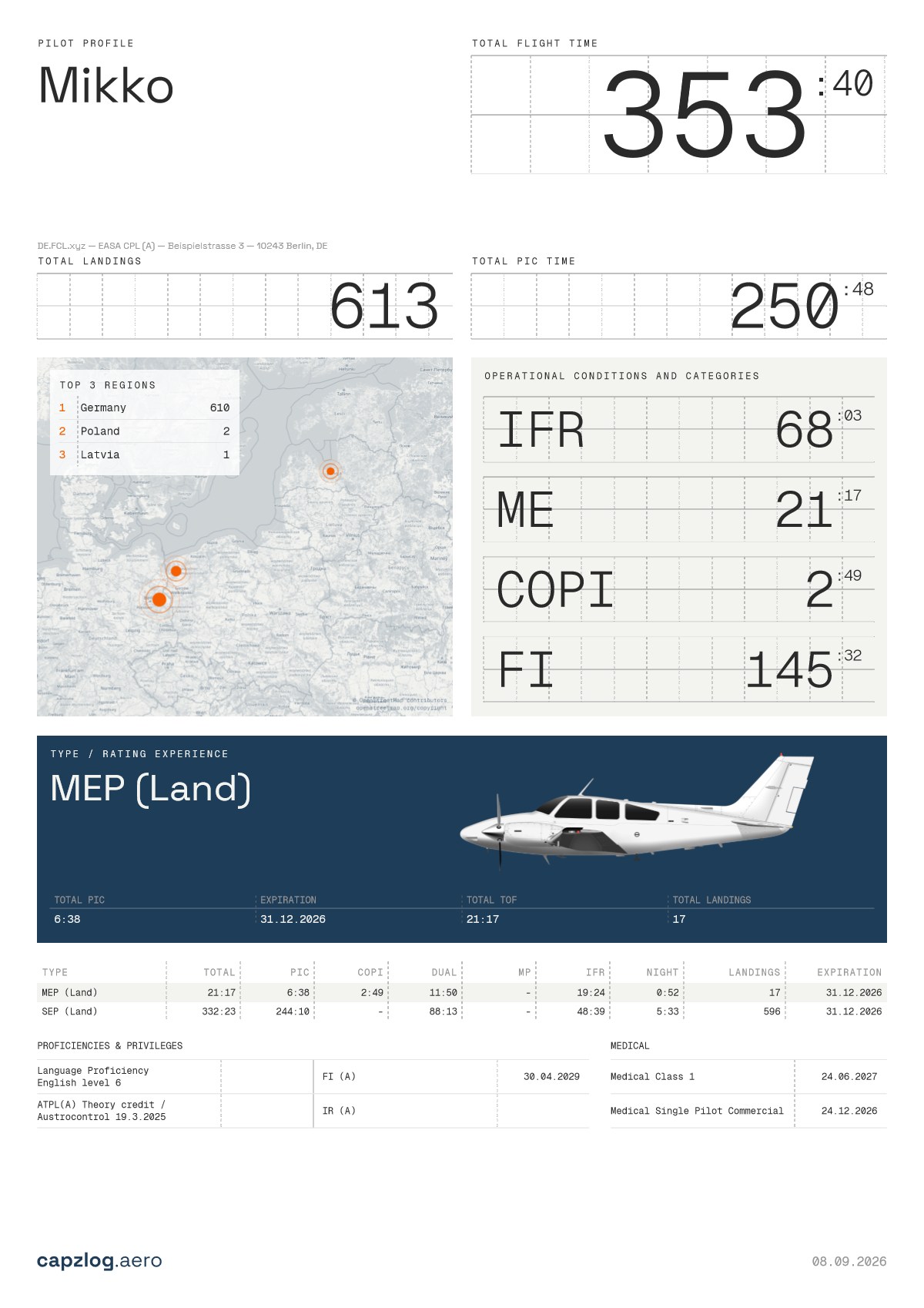
For the actual proof of experience in an application, copies of the logbook are often required. Adding a cover sheet with total experience to a CV is never a bad idea. Note that different logbook formats are recognized depending on the employer's country, though the EASA standard enjoys wide recognition worldwide.
Form and content
Human resources staff at airlines and operators are accustomed to processing a large number of applications in a very short time. Many decisions are demonstrably made on the basis of superficial impressions. Helping the recruiter quickly identify the right information with a clear, well-organized dossier gives a decisive advantage over candidates with confusing documents or hard-to-find experience data, and significantly improves the likelihood of being considered.
After the initial review and filtering, dossiers are examined more closely and checked against all required proofs. Here too, a good and well-kept overall impression improves the chances of being invited to an interview. In an era of AI-generated CVs and cover letters, the logbook is particularly well suited for standing out and making an impression with high-quality work.
Further career steps: FI, TRI, SFI
Many commercial pilots crave variety after a few years in the profession. Options include moving from business aviation to an airline or vice versa, as long as one does not fly for an airline with a seniority list. Additional training as a flight instructor is also popular, whether as a Type Rating Instructor (TRI), a Synthetic Flight Instructor (SFI), a Class Rating Instructor (CRI) or a Flight Instructor (FI).
Whatever path is chosen, all additional licenses require evidence of the necessary experience before the authority. A well-maintained and clearly structured logbook makes this process significantly easier.